- Fitness
Zone 2 Cardio: Benefits, Heart Rate, Workouts and How to Start

- Sep 08, 2026
- 4 min
Key Takeaways
-
Zone 2 training uses a controlled, sustainable intensity to build aerobic fitness and endurance.
- Walking, running, cycling and swimming can all be used for Zone 2 training.
- The talk test and heart rate data can help you judge whether your exercise intensity is appropriate.
- Beginners should start with manageable sessions and gradually increase duration rather than pushing intensity.
- Zone 2 can complement high intensity and strength training as part of a balanced fitness routine.
Not every workout needs to leave you exhausted. In fact, some of the most useful endurance training can feel surprisingly controlled.
Zone 2 training has become increasingly popular among runners, cyclists, fitness enthusiasts and people simply looking to improve their aerobic fitness. The idea is straightforward: spend enough time exercising at a manageable intensity to challenge your aerobic system without turning the session into a hard workout.
Training zones represent different exercise intensities, from easy and sustainable effort to near maximal work. Lower zones like Zone 1 can usually be maintained for longer, while higher zones like Zone 3 place greater demands on the body and require more recovery.
This fits within broader physical-activity guidance. The American Heart Association recommends at least 150 minutes of moderate-intensity aerobic activity per week for adults, while also recommending that activity levels and intensity increase gradually.
What Is Zone 2 Training?
If you are new to aerobic exercise, it may help to first understand what aerobic training means before looking more closely at Zone 2.
Zone 2 generally refers to a relatively low intensity training range where you can sustain exercise for a prolonged period without reaching the point of heavy breathing or rapid fatigue.
The exact boundaries are not identical for everyone. Different systems use different methods to define training zones, which is why treating one fixed heart rate percentage as a universal Zone 2 number can be misleading.
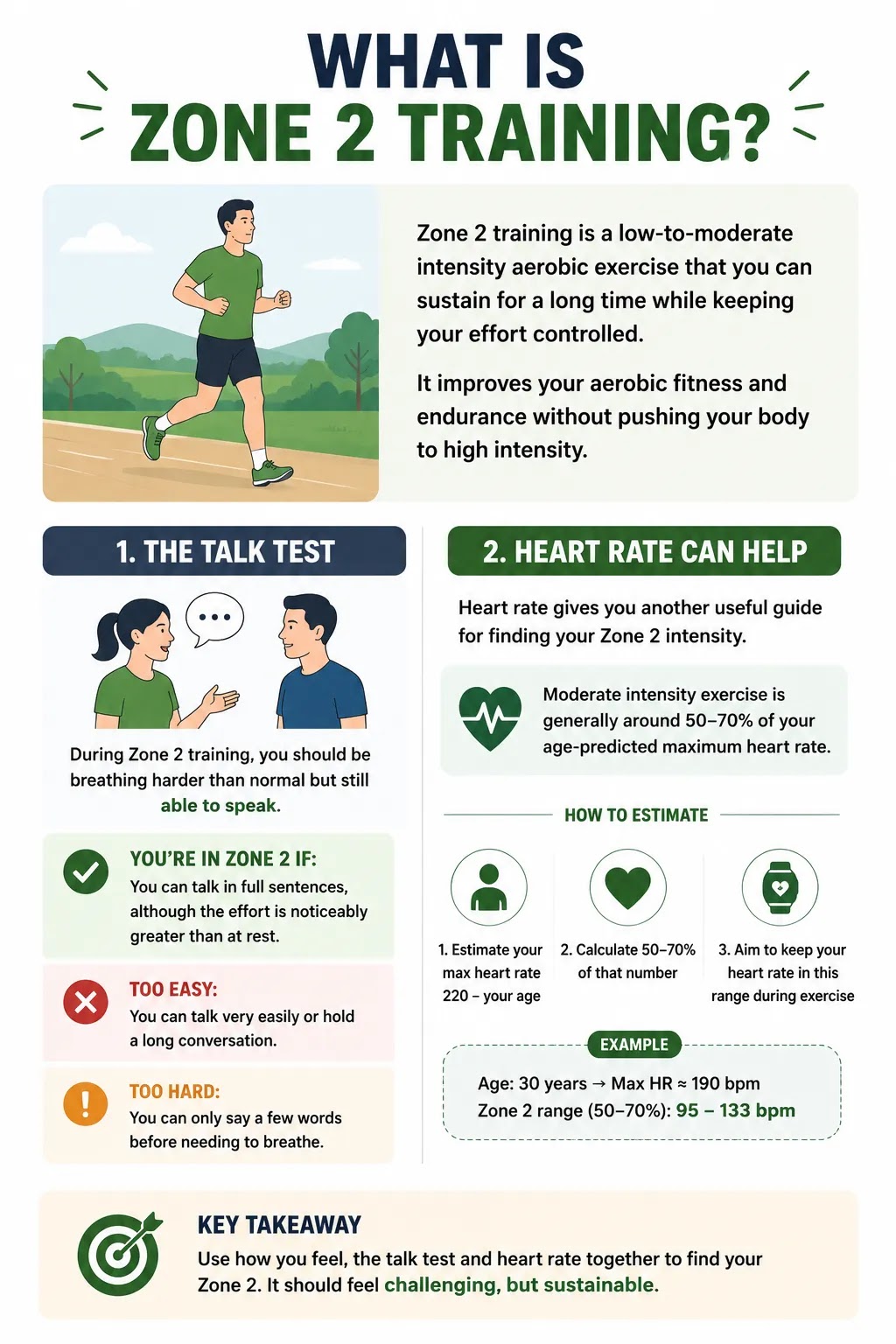
1. The Talk Test
One practical way to judge the intensity is the talk test.
During moderate exercise, you should be breathing harder than normal but still able to speak. The American Heart Association describes moderate intensity in similar terms: you can talk, although the effort is noticeably greater than at rest.
If you can comfortably hold a long conversation, the effort may be quite easy. If speaking even a short sentence feels difficult, you are probably working considerably harder.
2. Heart Rate Can Help
A heart rate monitor can provide another useful reference point.
Moderate intensity exercise is generally estimated at around 50–70% of age predicted maximum heart rate. However, this range is only a general guide and may not reflect the ideal training intensity for every individual.
For that reason, heart rate is best viewed alongside how the exercise actually feels.
What Are the Benefits of Zone 2 Training?
The main appeal of Zone 2 is that it allows you to accumulate aerobic work without making every training session highly demanding.
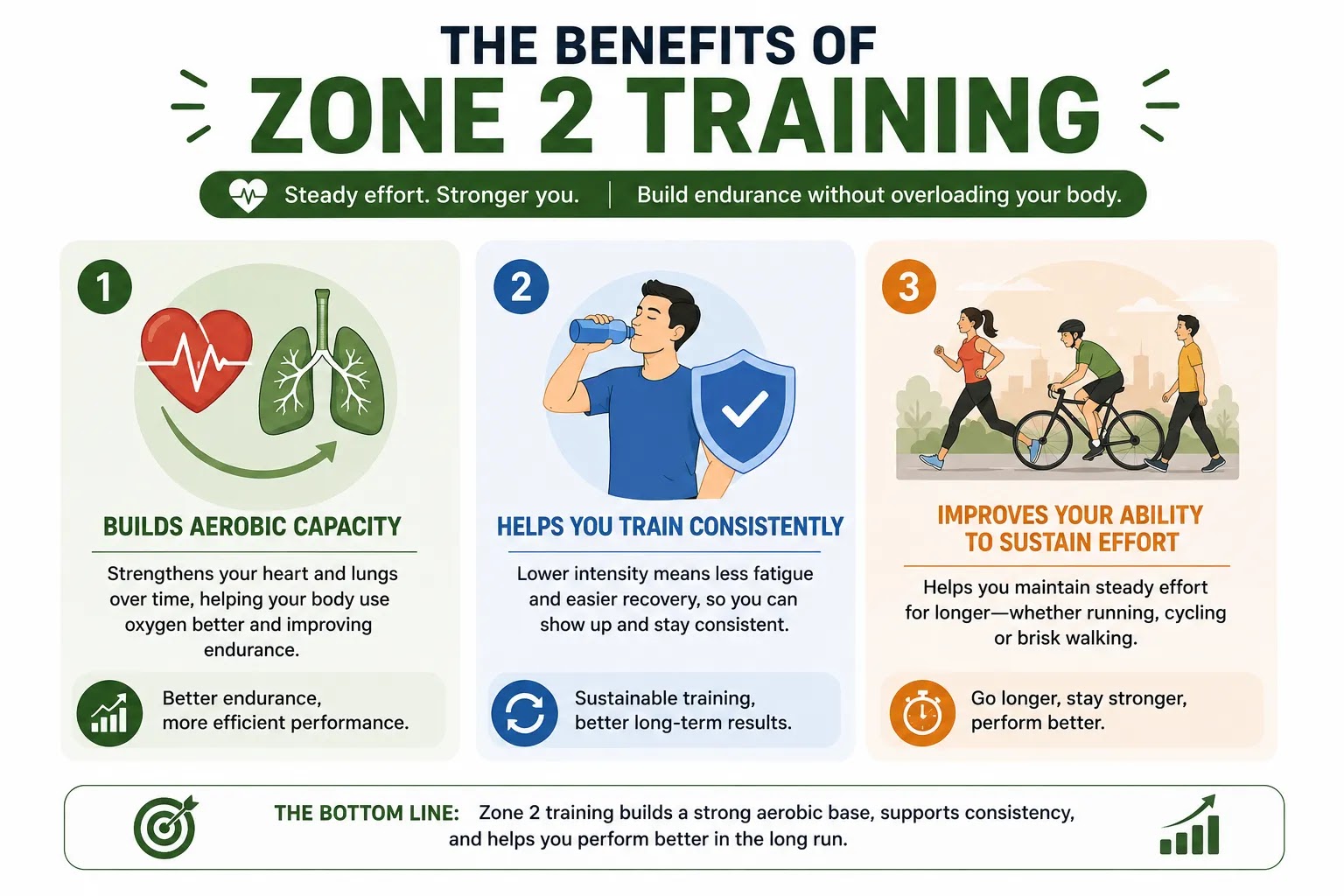
1. Builds Aerobic Capacity
Steady aerobic exercise challenges the cardiovascular system over an extended period. Regular aerobic activity is associated with improvements in cardiovascular and respiratory function, including adaptations that improve the body's ability to use oxygen during exercise.
This can contribute to better endurance and make sustained activities feel more manageable.
2. Helps You Train Consistently
Because the intensity is controlled, Zone 2 sessions can generally be easier to recover from than repeated high-intensity workouts.
That does not mean recovery is unnecessary. It means you can use lower-intensity aerobic sessions as part of a broader training programme without making every workout a major stressor.
3. Improves Your Ability to Sustain Effort
Zone 2 is particularly relevant to activities where you need to keep moving for a long time.
For a runner, that might mean maintaining an easy pace. For a cyclist, it could mean riding steadily for an extended period. For someone building general fitness, brisk walking may provide an appropriate starting point.
How to Get Started With Zone 2 Training
The easiest way to begin is not by obsessing over a perfect number on a smartwatch. Start by learning what a controlled aerobic effort feels like.
1. Start With Shorter Sessions
If you are currently inactive, begin with a manageable duration rather than immediately trying to complete long sessions.
For example, you could start with a 20–30 minute brisk walk and gradually increase the duration as your fitness improves.
2. Keep the Intensity Under Control
A common mistake is making every session progressively harder.
Zone 2 is supposed to be controlled. If your breathing becomes noticeably laboured or you cannot speak comfortably, reduce the pace or resistance.
3. Increase Duration Gradually
Once a particular duration becomes comfortable, add a little more time rather than dramatically increasing intensity.
The American Heart Association also recommends increasing activity gradually as your body becomes accustomed to exercise.
Conclusion
Zone 2 training is essentially about making aerobic exercise steady, sustainable and purposeful.
It does not require an expensive device or a complicated programme. Walking, cycling, running or swimming can all become Zone 2 sessions when performed at an appropriate intensity.
The bigger lesson is that fitness does not always improve by pushing harder. Sometimes, spending enough time at a controlled intensity is exactly what your training needs.
Recommended Products From FASC Coach
Frequently Asked Questions
1. Is Zone 2 training good for beginners?
Yes, it can be a practical way for beginners to develop aerobic fitness, provided the duration and intensity are appropriate for their current fitness level.
2. Can walking be Zone 2 training?
Yes. A brisk walk can fall within a moderate aerobic intensity, although the appropriate pace differs between individuals.
3. How do I know if I am in Zone 2?
Use a combination of effort, breathing and, if useful, heart-rate data. Being able to speak while exercising is a practical indicator of moderate intensity.
4. Can I do Zone 2 every day?
Some people can tolerate frequent low-intensity aerobic activity, but the right frequency depends on your overall training load and recovery.
5. Does Zone 2 replace strength training?
No. Aerobic and strength training develop different aspects of fitness, and both are recommended as part of a balanced physical-activity routine.
Share :
Recent Blog


- Sep 04, 2026