- Sports
Dynamic vs Static: Which Stretching Is Better Before and After a Workout?
- Oct 27, 2026
- 5 min
Key Takeaways
- Dynamic stretching is generally the better choice before most workouts.
- Static stretching is useful for improving flexibility and can fit well after exercise.
- Begin with light activity before stretching, especially before intense training.
- Avoid bouncing, forcing movements or stretching into pain.
- Stretching alone does not guarantee injury prevention or faster recovery.
- Regular practice and correct technique matter more than pushing your limits.
Stretching is often treated as a small part of a workout, something people do quickly before getting started or at the end of a session. But the type of stretching you choose can make a difference to how you prepare for exercise and improve flexibility over time.
Dynamic and static stretching are the two common approaches, and each serves a different purpose. The American Orthopaedic Society for Sports Medicine’s guide to flexibility and stretching explains how these techniques can support flexibility and activity preparation.
So, which one should you choose before and after a workout? The answer depends on what your body needs and the type of exercise you plan to do.
What Is Dynamic Stretching?
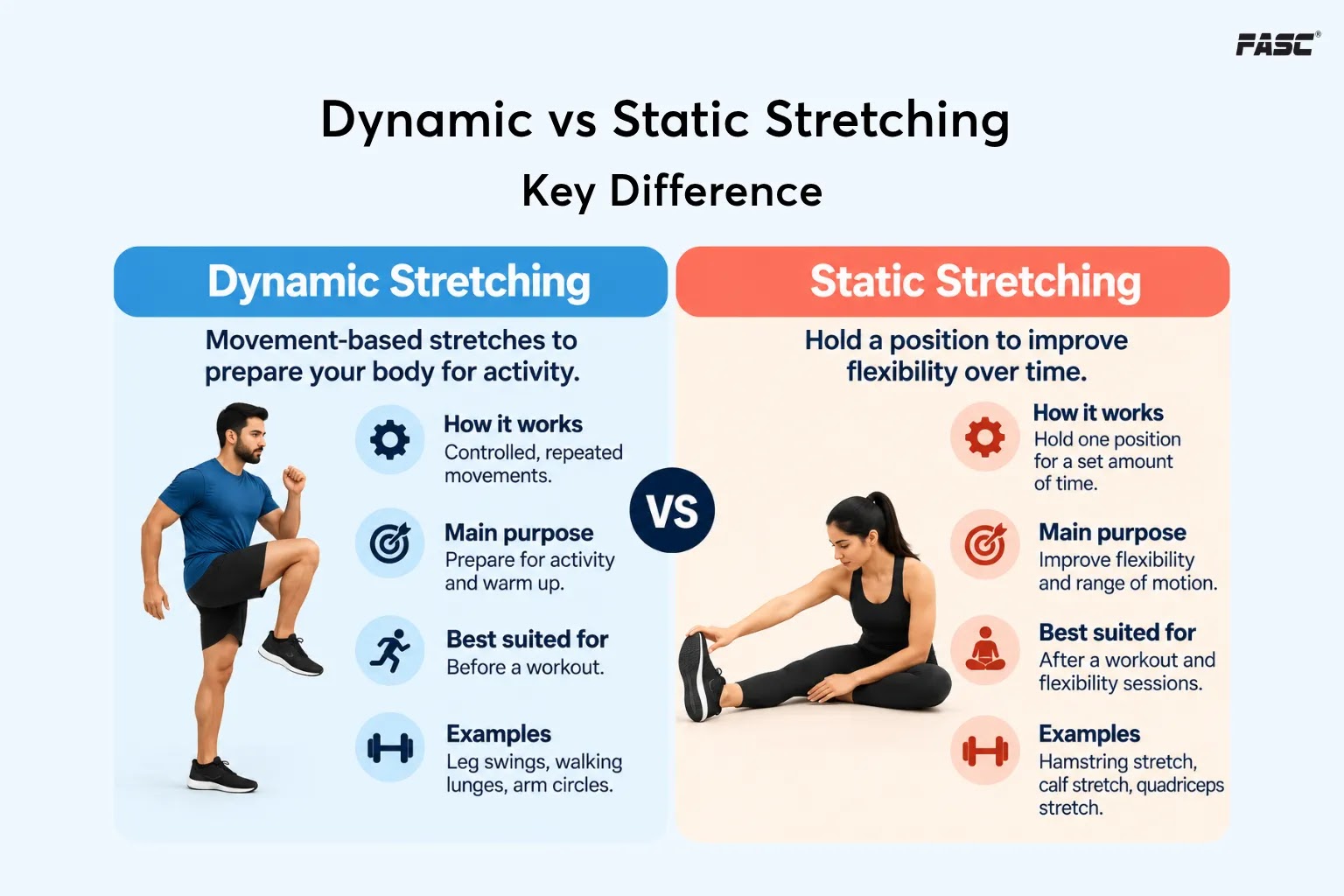
Dynamic stretching consists of moving your muscles and joints through a controlled range of motion without staying in any one position for a long time. This type of movement slowly readies your body for the activity that lies ahead.
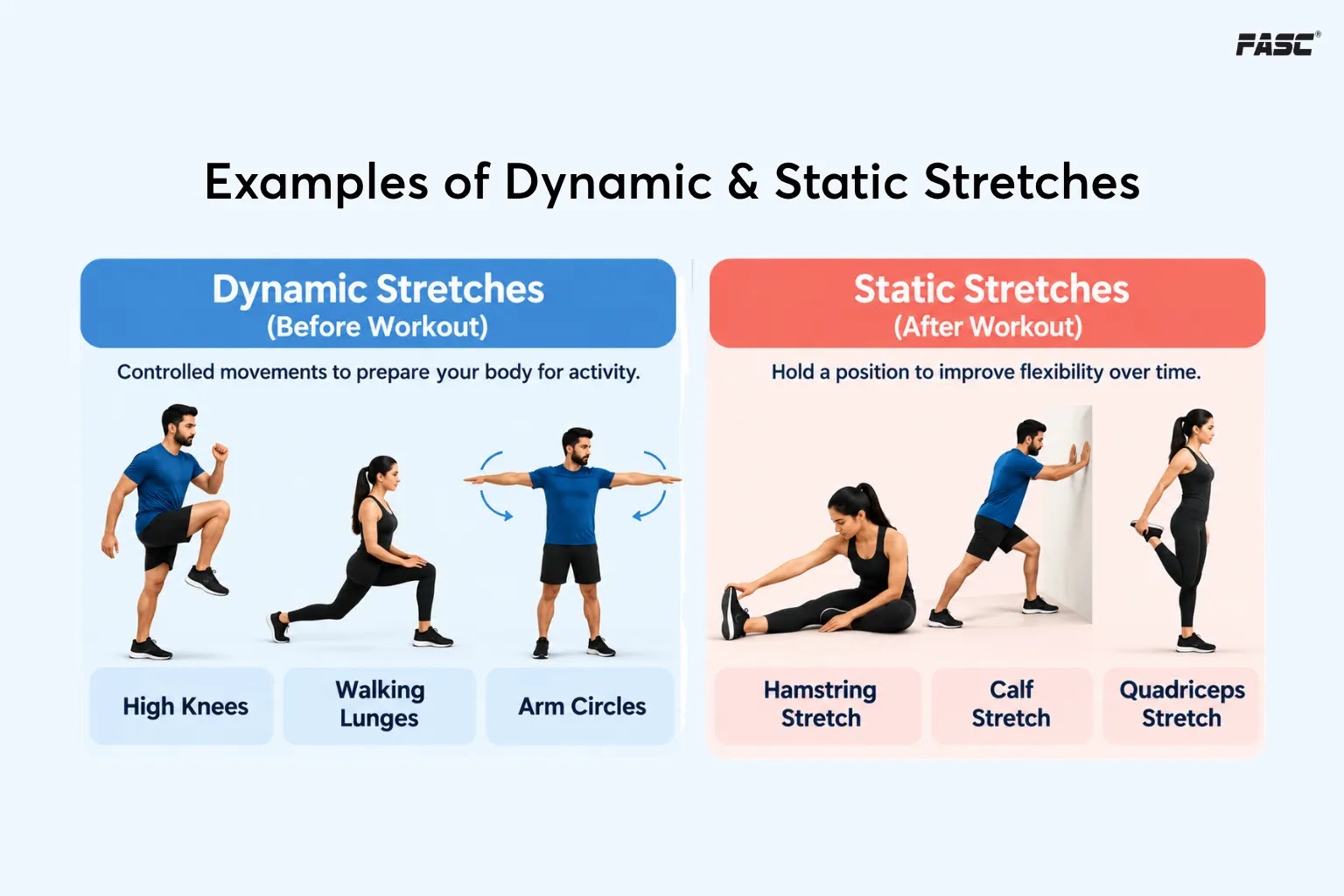
For example, leg swings, walking lunges, arm circles and high knees are all typical examples of dynamic stretching.
It is especially useful to do dynamic stretching before exercising since it gets you moving, raises your body temperature and allows you to practice movements that are similar to those used in your workout.
Examples of dynamic stretches:
-
Arm circles: Rotate your arms in small and gradually larger circles.
-
Leg swings: Hold a support and swing one leg forward and backward in a controlled manner.
-
Walking lunges: Step forward, lower your body comfortably and alternate legs.
-
High knees: Walk or jog on the spot, lifting your knees without forcing the movement.
Start slowly and increase the range of motion as you warm up. Stretching should feel controlled, not rushed.
What Is Static Stretching?
Static stretching consists of moving into a stretch and then holding that position for a certain length of time; rather than going through a range of motion repeatedly, you remain still while the muscle being stretched gets longer.
It is usually used in order to improve flexibility and the range of motion of the joints over time.
Examples are things like holding a stretch for the hamstrings, stretching the calves against a wall or doing a standing stretch for the quads.
Examples of static stretches:
-
Hamstring stretch: Extend one leg and gently lean forward from your hips until you feel a stretch behind your thigh.
-
Quadriceps stretch: Stand upright, hold your ankle behind you and gently bring your heel towards your glutes.
-
Calf stretch: Place your hands against a wall, step one foot back and keep the back heel on the floor.
-
Chest stretch: Place your forearm against a wall and gently turn your body away.
Hold each stretch for around 15–30 seconds as a practical starting point, breathing normally and avoiding bouncing. You should feel mild tension, not pain.
What Kind Of Stretching Is Better Before a Workout?
Dynamic stretching is usually the preferable option when doing a workout since it slowly readies both your muscles and joints for the movements you are going to carry out.
For example, if you're going for a run, start with five minutes of slow walking and then do some leg swings along with controlled walking lunges. Before carrying out a strength exercise session, do some arm circles, bodyweight squats and light repetitions of the movements you intend to perform.
As for stretching statically before exercise, it isn't automatically bad. It might, however, temporarily decrease performance if deep stretches are held for a long time just before taking part in activities that demand maximum strength, speed or explosive power. Still, short static stretches can be suitable when required, particularly when they are combined with a full warm-up.
What Kind Of Stretching Is Better After a Workout?
Static stretching is a practical choice after a workout, especially when one of your aims is to increase flexibility; once your exercise is over, slow and controlled stretches can be used to work on the range of motion in particular muscles.
For instance, after a run you could stretch your calves, hamstrings and quadriceps and, after an upper-body workout, more appropriate would be some gentle stretches of the chest and shoulders.
It is important to note that while static stretching might help to increase flexibility, it by no means guarantees that muscle soreness can be prevented or that recovery will be speeded up. Moreover, a reasonable recovery routine should take into account sufficient rest, proper hydration, good nutrition, and appropriate training loads.
The stretches mentioned here can easily be included in a home exercise routine together with the movements and equipment discussed in our guide to home workout tips and equipment.
How Frequently Should You Stretch?
It is more important to maintain consistency than to aim for the greatest possible flexibility during a single session. If getting an improved range of motion is a priority, then you should stretch regularly rather than depending just on a few minutes taken after an occasional workout.
You can also carry out stretching in conjunction with other exercises. For instance, yoga makes use of various poses and sequences of movement which may involve flexibility exercises, balance, and breathing. The most suitable method will vary according to your objectives, as set out in the comparison of yoga and stretching for flexibility.
Recommended Products From FASC Coach
Conclusion
Dynamic and static stretching work best when you use them for the right reasons. Use controlled movement to prepare for your workout, and make time for static stretches when you want to work on flexibility. You do not need a complicated routine; a few well-chosen exercises performed consistently can be a useful place to start.
If you have a current injury, persistent pain or a medical condition that affects movement, consult a qualified healthcare professional before starting a new stretching routine.
Frequently Asked Questions
1. Should I be doing dynamic or static stretching?
Honestly, you need both, it just depends on when. I always tell people to use dynamic stretches to get blood flowing before a workout, and save the static holds for after when you’re cooling down and working on mobility.
2. Is it okay to stretch before I lift?
Yeah, but stick to dynamic moves. Holding deep stretches right before a heavy lift actually robs you of power. Just get your heart rate up, do a few dynamic movements, and hit a couple of light warm-up sets instead.
3. How long am I supposed to hold a stretch?
About 15 to 30 seconds is plenty. You're looking for a comfortable tug, not pain. Just take deep breaths and whatever you do, don't bounce.
4. Will stretching keep me from getting injured?
It definitely helps keep you mobile, but it's not a get-out-of-jail-free card. You’re much less likely to get hurt if you focus on good form, warm up properly, and don't rush your weight progressions.
Share :