- Sports
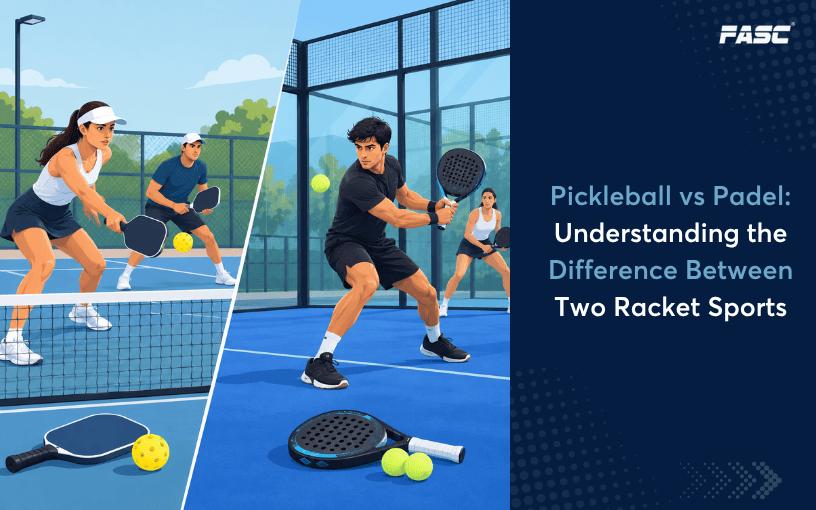
Pickleball vs Padel: Understanding the Difference Between Two Racket Sports
- Oct 16, 2026
- 6 min
Key Takeaways
- Pickleball is played on a smaller court with a solid paddle and perforated plastic ball.
- Padel is played on an enclosed court using a perforated racket and a pressurised ball.
- Pickleball involves quick reactions, short movements and plenty of play around the non-volley zone.
- Padel requires more court coverage and introduces walls as part of the game.
- Both sports can improve agility, coordination, balance and cardiovascular fitness.
- Your choice ultimately comes down to the kind of game and workout you enjoy.
What Makes Pickleball Different?
Pickleball is played on a relatively compact court, which is one of the first things a new player notices. The equipment is also quite distinctive: instead of a traditional stringed racket, players use a solid paddle along with a lightweight plastic ball containing holes.
The game becomes particularly interesting near the net. Pickleball has a non-volley zone, commonly known as the “kitchen”, where players cannot hit a volley while standing inside the area. This changes the way points are constructed. Simply hitting the ball harder is not always the answer.
A well placed shot, a little patience and a quick reaction can often be more useful than raw power.
That accessibility is part of pickleball's appeal. Someone can pick up the basics fairly quickly, while experienced players can spend years improving their positioning, shot selection and tactics. Its growing popularity has been remarkable, as explored in our look at the rapid growth of pickleball.
Physically, pickleball is not necessarily a relaxed game. The court may be small, but players are constantly making short movements, changing direction and reacting to shots coming back at them.
What Makes Padel Different?
Padel has a very different feel.
Most padel games are played in doubles on an enclosed court. Glass and mesh walls surround the playing area, and those walls are not simply there to stop the ball from leaving the court. They are part of the game.
After the ball bounces, players can use the walls to keep a rally going or create an attacking opportunity. That means a padel player has to think about more than just where the opponent is standing. The angle and direction of the rebound can change the next shot completely.
The equipment is different too. Padel uses a solid racket with perforations and a pressurised ball that is similar to a tennis ball.
Movement is another noticeable difference. There is more ground to cover, and players regularly accelerate, stop, turn and move back into position. Because doubles are so common, communication with your partner becomes an important part of the game.
Pickleball vs Padel: Where Do They Really Differ?
1. Court Size and Layout
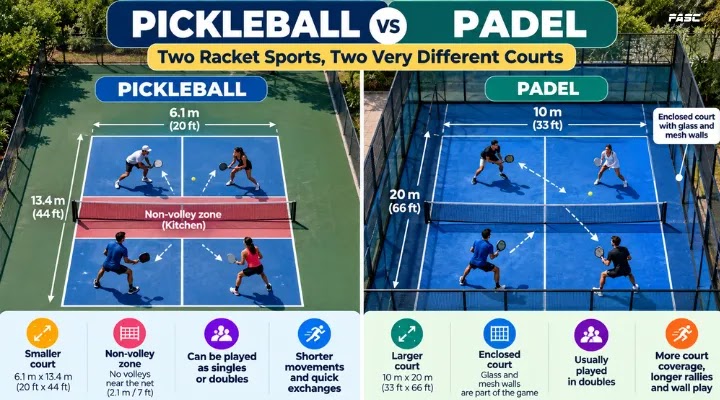
The court is one of the first things you'll notice when you compare pickleball and padel.
Pickleball is played on a smaller open court so you don't necessarily have to cover as much ground in a rally. It's very much a game of quick reaction, good positioning and of course getting the ball where your opponent can't quite reach it.
Padel is played on a bigger, enclosed court and the walls make a massive difference. The ball can hit the glass and stay in play, which can give you a second chance to return a shot you thought you'd just missed. You've got to be aware of your opponent as well as how the ball might bounce off the walls.
If you like taking shots and using the court to your advantage then padel presents an additional tactical dimension.
2. Rackets and Balls
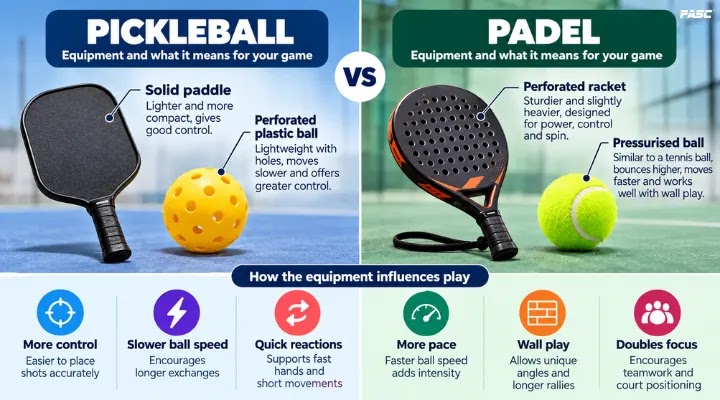
Each sport has its own character because of the equipment.
Pickleball employs a solid paddle and a plastic ball with holes in it; this ball is lighter and differs in behaviour from the ball used in padel.
Padel rackets are also solid and have holes in them. The ball is pressurised, which gives the rallies a different speed and feel.
When it comes to choosing equipment, people who are just starting out should put comfort first. It doesn't have to be the most expensive racket or paddle that is right for them. The decision should take into account factors such as your level of experience, how often you play and your fitness objectives, just as the considerations mentioned in our guide on selecting sports equipment according to your fitness goals.
3. Movement and Fitness
This is where personal preference starts to matter.
Pickleball relies heavily on quick reactions and short bursts of movement. Players move side to side, step forward and backward, and react rapidly to shots at close range. Over a full game, those movements can add up to a surprisingly demanding workout.
Padel generally involves more movement around the court. Players have to cover space, recover after shots and react to balls coming off the walls. There can be plenty of acceleration and changes of direction during a long rally.
So which gives you a better workout?
There isn't one universal answer. A competitive pickleball game can be extremely energetic, while a casual game of padel may be much less demanding. Your playing style and intensity matter just as much as the sport itself.
4. Strategy and Playing Style
Pickleball often rewards control.
Players may use soft shots, carefully placed returns and patient exchanges to create an opening. The kitchen also changes how players approach the net.
Padel has its own strategic language. Players have to consider wall rebounds, court position, lobs, angles and communication with their partner.
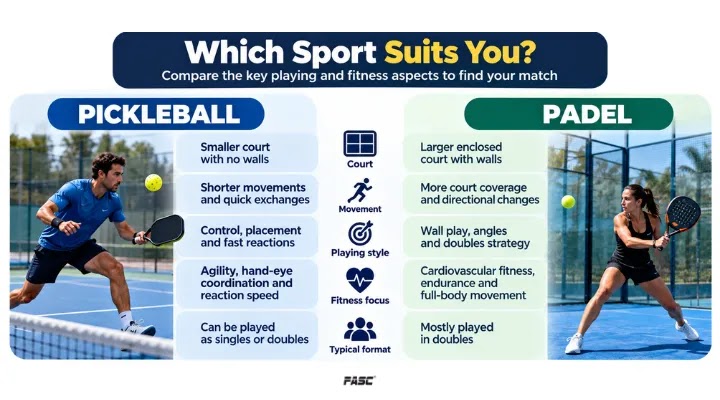
In simple terms, pickleball often puts a lot of emphasis on precision and quick reactions, while padel adds movement, positioning and wall play to the equation.
Recommended Products From FASC Coach
Conclusion
Pickleball and padel might look similar at first, but once you play them, you’ll notice quite a few differences. Pickleball is played on a smaller court and focuses on quick reactions, smart shot placement and controlled rallies. Padel, on the other hand, brings walls into play, making movement, positioning and teamwork especially important.
Neither sport is better than the other. It really comes down to what you enjoy and what suits your fitness level. If you prefer quick exchanges and a compact court, pickleball might be for you. If you enjoy longer rallies and using the walls to your advantage, give padel a try.
At the end of the day, the best sport is the one you enjoy enough to keep coming back to.
FAQs
1. Is pickleball easier to learn than padel?
At first, pickleball may seem easier due to the smaller court and the simple equipment available. Yet a high level of skill can only be achieved through a great deal of practice, particularly in terms of positioning and choosing your shots.
2. Is padel identical as tennis?
No, while padel has some features in common with tennis it has its own court, racket, set of rules and way of playing; the enclosed walls are one of its most important differences.
3. Which of the two sports, pickleball or padel, is more physically demanding?
It all comes down to the way you play; padel generally requires more court coverage whereas pickleball depends a great deal on quick and repeated movements. Competitive games in either of these sports can give a strenuous workout.
4. Can a person who has no experience in racket sports take up pickleball or padel?
Certainly. Both of the sports are suitable for people who are just starting out; if you get some advice on the basic techniques and on positioning on the court from a coach or an experienced player, your first few lessons will be a lot easier.
5. Which is the better sport in terms of fitness?
Both of them can keep fit by means of regular play; pickleball is especially good for improving agility, reaction speed and short bursts of movement, whereas padel involves more running, more changes of direction and greater court coverage.
Share :