- Sports
What Is the Difference Between Field Hockey and Ice Hockey?

- Aug 25, 2026
- 5 min
Key Takeaways
- Field hockey and ice hockey share the same objective but differ in their rules, playing surfaces and movement.
- The surface shapes the game, with field hockey built around running and ice hockey centred on skating.
- Field hockey uses a ball, while ice hockey uses a puck, creating different technical demands for players.
- Both sports require high fitness levels, but field hockey emphasises endurance and agility while ice hockey demands explosive power, balance and recovery.
- Understanding these differences helps players choose the right sport and train for the specific demands of the game.
At first glance, field hockey and ice hockey seem related. Both involve sticks, goals, teamwork and the challenge of moving an object past a goalkeeper. The similarities, however, end very quickly.
Field hockey is played on a pitch with a ball, while ice hockey is played on an ice rink with a puck. The official rules of field hockey are governed by the International Hockey Federation (FIH), while ice hockey is governed by International Ice Hockey Federation (IIFH). Both organizations publish official rules for their respective forms of the game.
Field Hockey vs Ice Hockey: The Main Difference
There are a few but important distinctive points between both hockey. These differences show how players move, control the object and approach the game.
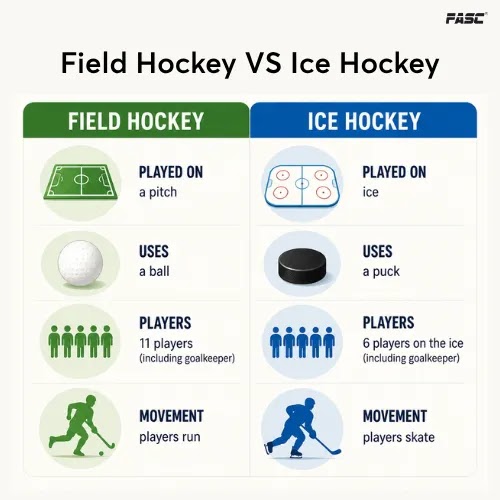
1. Ball vs Puck
There are many differences, so let’s start with the major difference is what players use to score.
Field Hockey Uses a Ball
The ball is moved using a hockey stick and generally travels across the surface of the pitch. Ball control requires close coordination between the player's movement and stick handling.
Ice Hockey Uses a Puck
Ice hockey uses a flat puck that slides across the ice. Because the puck moves on a low-friction surface and players are skating at high speeds, controlling it requires a different combination of stickhandling, timing and body control.
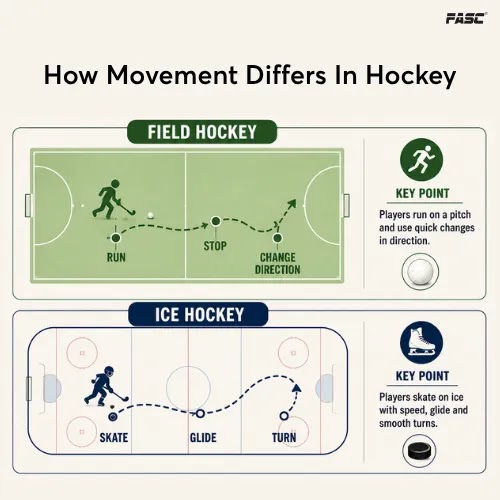
2. Playing Surface and Movement
The surface on which each sport is played has a major influence on how players move and how the game develops.
Field Hockey
Field hockey is played on a rectangular pitch, usually on a synthetic surface at the highest levels of the sport. Players move by running and use changes in speed and direction to create space or close down opponents.
Because players are constantly running, stopping and accelerating, lower-body strength, endurance and agility are important.
Ice Hockey
Ice hockey is played on an enclosed ice rink. Under IIHF rules, the official rink is 60 metres long and between 26 and 30 metres wide.
Players move by skating, which creates a completely different physical and technical challenge. Balance, edge control and skating technique become fundamental skills
The board surrounding the rink also affects the flow of play, as puck can remain in play after rebounding from them.
3. Number of Players and Equipments
Traditional outdoor field hockey is played with 11 players per team, including a goalkeeper.
In ice hockey, teams have 6 players on the ice at one time, including a goalkeeper. The remaining players can be substituted during the game, and line changes are an important part of sport.
Field Hockey Equipment
Field hockey players use a stick designed for controlling and striking the ball. Goalkeepers wear substantial protective equipment, while outfield players generally use less protective gear.
Common equipment can include:
- Hockey stick
- Shin guards
- Mouthguard
- Footwear suitable for the playing surface

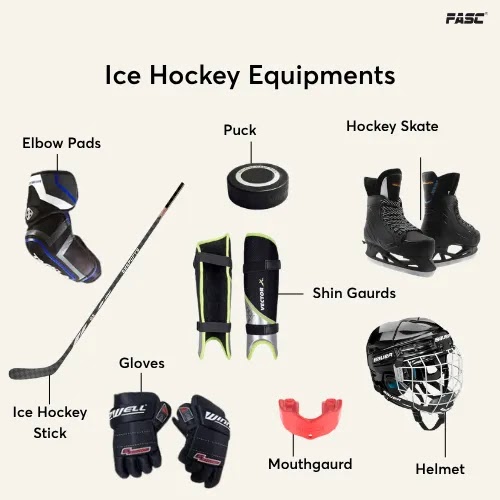
Ice Hockey Equipment
Ice hockey requires more extensive protective equipment because of the speed of the game, the hard puck and the possibility of physical contact.
Players typically wear:
- Helmet
- Shoulder pads
- Elbow pads
- Gloves
- Protective shorts
- Skates
Goalkeepers wear specialised protective equipment, including a helmet, gloves and large leg pads.
4. How the Rules Differ
Both sports have their own offside rules, penalties and methods of restarting play, but the details are not the same.
Field Hockey Rules
Field hockey is based around passing, ball control and scoring from within the designated shooting circle. Physical contact is more restricted, and players cannot use their bodies to block opponents from reaching the ball.
The game also includes set piece situations such as penalty corners and penalty strokes.
Ice Hockey Rules
Ice hockey has face offs, offside and icing rules that shape the flow of the game. Penalties can result in a player spending time in the penalty box, leaving their team temporarily short handed. This creates situations such as power plays.
The IIHF also recognizes the physical nature of the game within its rules, including regulations relating to body contact and other forms of physical play.
5. Physical Demands of Each Sport
Both sports demand a high level of fitness, but the physical requirements are different.
Field hockey requires:
- Aerobic fitness
- Repeated sprint ability
- Agility
- Strength
- Change-of-direction ability
- Technical coordination
Players need to run for extended periods while also producing repeated high-intensity actions.
Ice Hockey Requires
- Skating techniques
- Explosive power
- Balance
- Repeated high-intensity efforts
- Physical strength
- Coordination at speed
Because players are frequently substituted, the game often consists of short but intense periods of activity.
Conclusion
Field hockey and ice hockey share a few basic ideas, but they are distinct sports with different rules, equipment and physical demands.
Field hockey is built around running, ball control and movement across a pitch. Ice hockey combines skating, puck handling and high speed play on an enclosed rink.
The biggest difference may be the surface, but that difference influences everything from the skills players need to the way each game is played.
Recommended Products From FASC Coach
Frequently Asked Questions
Can the skills learned in field hockey transfer to ice hockey?
Some skills can transfer, including spatial awareness, anticipation, teamwork and general stick coordination. However, skating, puck control and the movement demands of ice hockey require separate technical development.
Why does ice hockey have more player substitutions than field hockey?
Ice hockey involves short, high-intensity shifts, so players are substituted frequently to maintain speed and intensity. Field hockey has different physical demands and substitution patterns because players move by running rather than skating.
Why is the offside rule important in both sports?
Offside rules help prevent attacking players from simply waiting near the opponent's goal. However, the way offside is defined and enforced differs between field hockey and ice hockey.
Can you play field hockey and ice hockey using the same training programme?
Both sports benefit from strength, conditioning and coordination, but field hockey training needs to prioritise running and repeated changes of direction, while ice hockey training must also account for skating-specific movement and explosive shifts.
Which sport is better for beginners: field hockey or ice hockey?
It depends largely on access and previous experience. Field hockey may be easier to begin if you are already comfortable running, while ice hockey requires learning skating alongside puck and stick skills
Share :